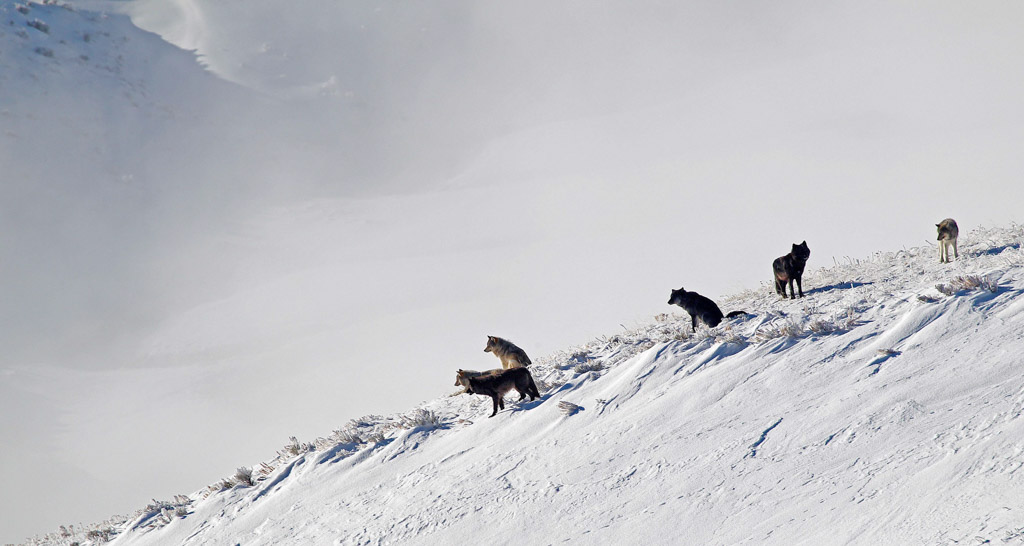
Mary Mountain Wolf Pack, photo by Dan Stahler / NPS
Wolf Bioacoustics Research
In the summer of 2023, Yellowstone Forever launched an ambitious bioacoustics research initiative to deepen our understanding of wolves. Led by Dr. Dan Stahler, head of the Yellowstone Wolf Project, in collaboration with Dr. Jeff Reed of Grizzly Systems and founder of The Cry Wolf Project, this study has created the world’s largest database of wild wolf vocalizations. It also represents the first large-scale effort to integrate bioacoustic monitoring with traditional wolf tracking methods.
What are Wolves Really Saying?
In Yellowstone National Park, wolves are constantly communicating—howling across valleys, whining within family groups, and signaling to one another in ways we are only beginning to understand. For decades, these sounds have been a defining feature of the Yellowstone landscape. But until recently, we didn’t have the tools to truly listen.
That is beginning to change.
At its core, this research asks a simple but profound question: what are wolves saying—how can we better understand it?
To answer that, researchers are working to understand:
- What vocalizations do wolves use, and when?
- How do wolves communicate within and between packs?
- Can sound alone be used to estimate pack size or presence across a landscape?
Listening to the Landscape
Bioacoustics is the study of how animals use sound. Instead of relying solely on visual observation or GPS data, scientists can now listen: capturing how wolves communicate across distance, within families, and in response to their environment.
Across Yellowstone, a network of autonomous recording units (ARUs) continuously documents the acoustic landscape. These devices operate in remote areas for extended periods of time, recording not only wolves but the broader ecosystem they inhabit.
Since the project began, researchers have recorded over 200,000 howling events and documented hundreds of distinct vocalizations. These recordings are paired with ground and aerial observations, allowing scientists to connect sound with pack size, individual wolves, and specific social contexts.
© Yellowstone Forever courtesy photo
Hearing Life as a Wolf
One of the most groundbreaking aspects of this research is the use of audio-recording GPS collars.
For the first time, wild wolves are being fitted with collars that capture not just location and movement, but sound—from the perspective of the animal itself. These devices record the acoustic world as wolves experience it, offering an unprecedented window into their daily lives.
Early findings reveal striking differences in behavior. Some wolves are highly vocal, frequently communicating with packmates, while others remain largely silent, except when in close proximity to other wolves.
In one case, a dispersing wolf remained almost entirely silent throughout its journey—behavior that may help avoid detection while searching for a new pack.
Why This Research Matters
For wolves, sound is essential.
Howls help reunite pack members, reinforce social bonds, and signal territory. Growls and snarls serve as warnings. Whines and whimpers can express submission, stress, or social connection. Each vocalization carries meaning shaped by context, relationships, and environment.
Yet much of what we know about wolves has come from what we can see. Bioacoustics offers a different lens—allowing researchers to study communication directly, and at a scale that was previously impossible.
In many ways, this research represents a shift toward listening rather than intervening—an approach that aligns with a growing emphasis on ethical, minimally invasive science.
Erin Stahler collaring black wolf, photo by Dan Stahler/NPS
© Yellowstone Forever courtesy photo
Vocal Fingerprints
Each wolf’s howl contains unique acoustic qualities. By analyzing these patterns, researchers hope to one day identify individual wolves—and even entire packs—based on sound alone.
If successful, this approach could significantly reduce the need for invasive research methods like trapping and collaring, while expanding the ability to monitor wolves across vast and remote landscapes.
Researchers are working towards this through the development of artificial intelligence tools to process the growing volume of audio data. These models can scan thousands of hours of recordings, identifying wolf vocalizations and detecting patterns far beyond human capacity.
Together, these advances could transform how wolf—and other wildlife—populations are studied, not only in Yellowstone, but around the world.
Our Role in This Work
Living with Wolves is proud to support this innovative research by helping fund the work, amplifying key findings, and connecting this science to broader audiences through storytelling, education, and outreach.
Jim and Jamie Dutcher are also contributing archival recordings of “mourning howls” from the Sawtooth Pack. These rare vocalizations are being used to help train the AI model to distinguish between different types of howls, while also bringing this science to life through public education.
© Yellowstone Forever Lead Field Educator Amanda Evans
© Jake Frank
Looking Ahead
As this body of research continues to grow, so does our understanding of wolves, not just as animals on a landscape, but as highly social beings navigating a complex world of communication.
This work is doing more than collecting data, it’s changing how we understand wolves. By pairing cutting-edge technology with traditional fieldwork, researchers are uncovering the social, behavioral, and communicative complexity of one of North America’s most iconic species.
And in doing so, bringing us closer to answering a question that humans have wondered about for centuries: what are wolves really saying?