
 2025 Annual Report
Dear Friends,
Do wolves play? Yes they do — all the time! As we began our work with the Sawtooth Pack in the 1990s, we had the opportunity to spend time with wolf biologist Dr. Gordon Haber in Denali National Park, Alaska.
At that time, he was conducting the longest continuous study of wolves in the world which began in 1939 by Adolph Murie. When Gordon died in 2009, we lost a meticulous scientist and an outspoken wolf advocate.
Few human beings have logged more hours observing wolves than the late Gordon Haber. He was a rigorous scientist, as evidenced by notebooks filled with minute-by-minute observations. Yet he was not afraid to step beyond pure science and acknowledge that wolves resonate in the human psyche in a way few other animals do.
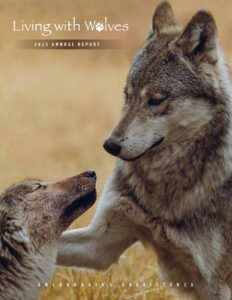
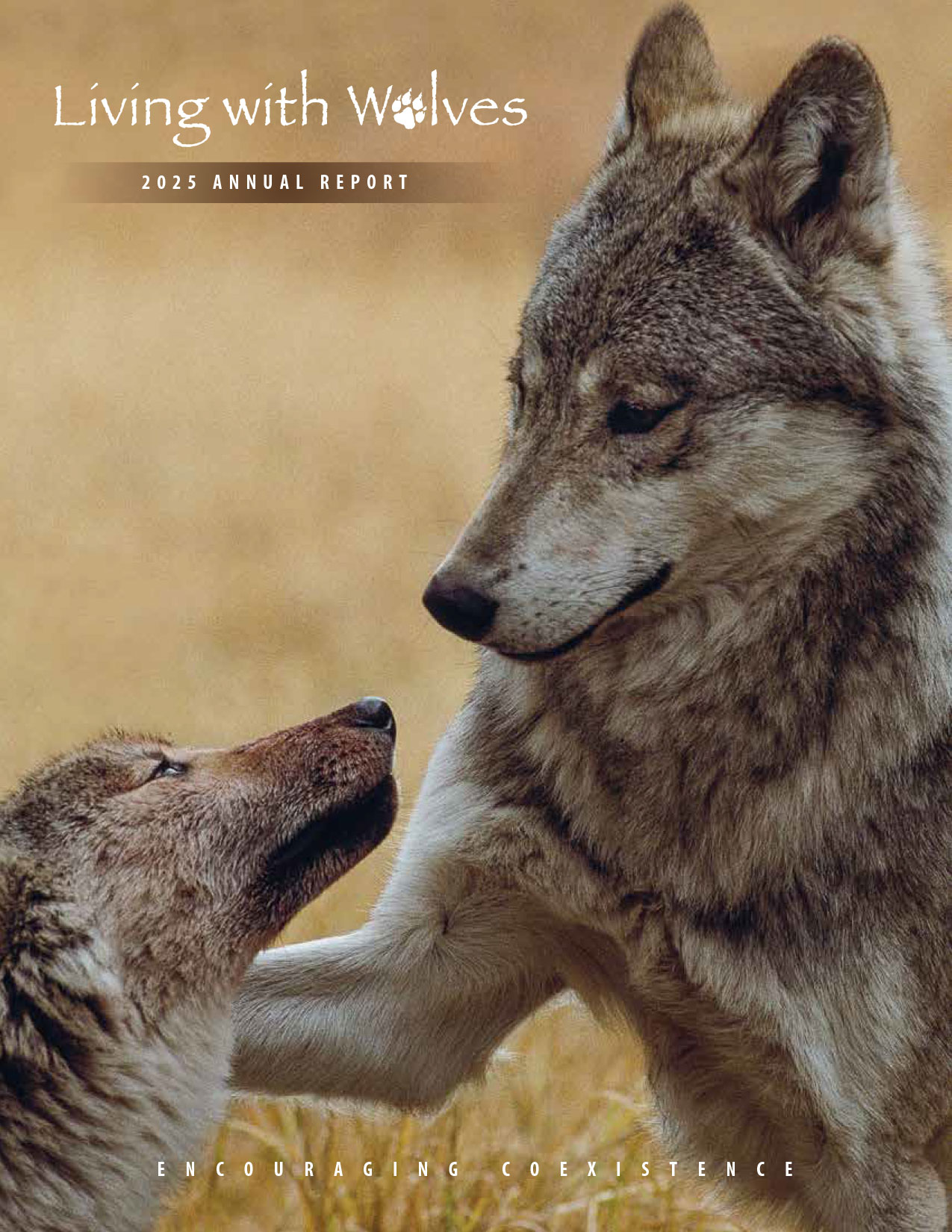
Seeing just how much the Sawtooth Pack played, we wondered about their wild cousins. Were wolves in the wild — who were more burdened by survival issues such as being hunted and avoiding rival packs — still likely to play? Gordon provided an answer. After spending a lifetime observing wolves in Alaska, he told us, “If a half hour passes without at least some play, it is an unusual half hour in the daily routine of a wolf family.”
It isn’t coincidental that wolves are at the same time probably the most playful, and the most socially cooperative of nonhuman animals. We both feel that Haber was ahead of his time in how he understood the social order of a wolf pack.
Where other biologists saw a family group of hunters, Gordon saw a shared culture and the passing of information over generations. He saw a true society in which play is the glue that holds it together.
Thank you for your continued support