

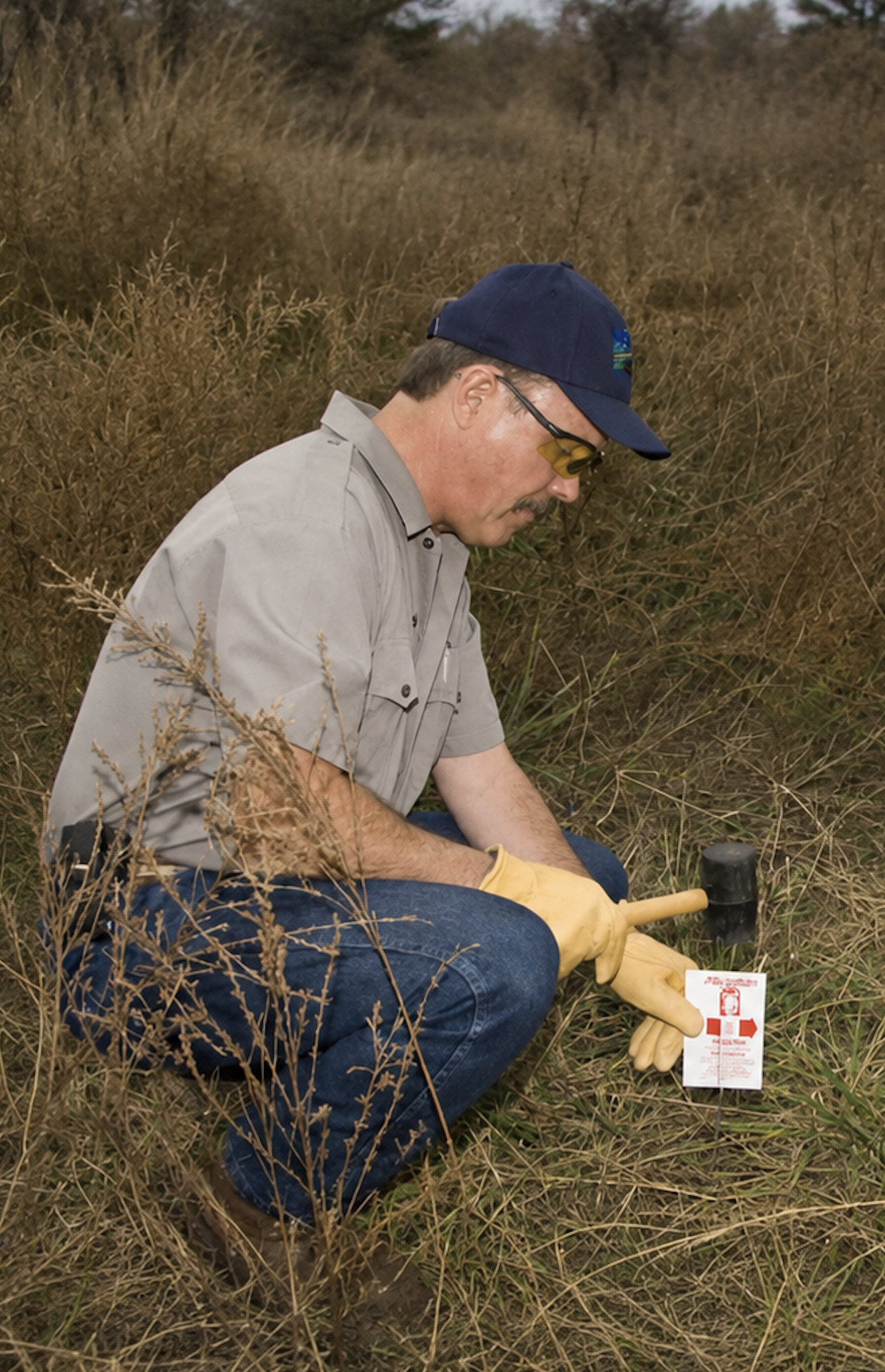
For decades, M-44 devices, commonly known as cyanide bombs, have been deployed across the American West as a predator control tool. Supporters argue they help reduce livestock losses caused by coyotes and other predators. Critics contend they are inhumane, indiscriminate, and pose unacceptable risks to wildlife, pets, and people. Despite growing public opposition, documented injuries, and repeated legislative efforts to ban them, M-44s remain legal in parts of the United States and were recently restored to public lands by the Trump administration after a brief federal prohibition. (photo: USDA Wildlife Services)
What Are M-44 Cyanide Bombs?
M-44s are spring-loaded devices designed to kill canids such as coyotes and foxes. The devices are baited with a scented lure intended to attract animals. When an animal pulls on the baited top, a spring mechanism ejects approximately 0.88 grams of sodium cyanide powder directly into the animal’s mouth and face. Upon contact with moisture, the sodium cyanide rapidly forms hydrogen cyanide gas, an extremely toxic poison. Animals exposed to the chemical often suffer convulsions, respiratory distress, and a painful death.
The Environmental Protection Agency (EPA) classifies sodium cyanide as a Category I toxicant—the agency’s highest level of toxicity concern.

While Wildlife Services and some livestock industry advocates maintain that M-44s are an effective predator management tool, the devices cannot distinguish between target and non-target animals. Like traps and snares, they can kill virtually any animal that activates them. According to USDA Wildlife Services data, more than 1,800 non-target animals were reportedly killed by M-44s between 2020 and 2024.
A History of Poisoning Predators
M-44s were developed in the 1960s as a replacement for an earlier cyanide delivery system known as the “Coyote Getter.” Used since the 1930s, the Coyote Getter relied on a modified .38 Special pistol cartridge to propel sodium cyanide into an animal’s mouth. The device proved dangerous to both wildlife and people, prompting the U.S. Fish and Wildlife Service to seek a safer alternative. Predator control specialist James Poteet patented the M-44 in 1967, and by the 1970s it had largely replaced the Coyote Getter. Although the delivery mechanism changed, the underlying philosophy remained the same: lethal predator control through poison.
At the time, wolves had already been eradicated from much of the Lower 48 states, so M-44s were primarily used against coyotes and foxes. However, because the devices are often placed on public lands, accidental encounters by pets, recreationists, and non-target wildlife have continued to occur. It wasn’t until a child was harmed in March 2017 that public awareness of and the movement to ban M-44s gained traction.
The Tragedy That Sparked a Movement
Fourteen-year-old Canyon Mansfield was walking his dog, Kasey, near his home in Pocatello, Idaho, when he noticed what appeared to be a sprinkler head protruding from the ground roughly 300 yards from his house.
Curious, he bent down to investigate.
The device exploded.
An orange cloud of sodium cyanide powder shot into Canyon’s face and eyes. As his skin burned, he ran to nearby snow to flush the substance from his eyes. Moments later, he heard Kasey crying out behind him. The dog collapsed into violent convulsions before dying at three years of age.
Canyon survived, but the effects lingered for years.
In testimony before Congress in 2022, Canyon’s father, physician Dr. Mark Mansfield, described the aftermath:
“This M-44 cyanide bomb, set by the U.S. Department of Agriculture’s Wildlife Services program, stole a cherished member of my family, an irreplaceable piece of my son’s innocence, and my entire community’s sense of security…I assert that public lands managers do not need any so-called ‘tool’ that can indiscriminately poison children, kill pets, and devastate families; nor does it need a ‘tool’ that does not know its ‘target.’”
Dr. Mansfield testified that Canyon suffered excruciating headaches, nausea, vomiting, numbness in his hands and arms, insomnia, and symptoms consistent with chronic cyanide poisoning for years following the incident. Medical providers initially struggled to determine how to treat him because there are no definitive tests for sublethal cyanide exposure.
In 2020, the federal government agreed not to contest negligence and pay the Mansfield family $38,500 to resolve a lawsuit stemming from the incident. The story drew national attention and introduced many Americans to the reality that cyanide bombs were being deployed on public lands.

Canyon Mansfield with his dog, Kasey. Photo: Theresa Mansfield
Growing Public Opposition
The Mansfield incident galvanized public opposition to M-44s. In its aftermath, twenty conservation organizations petitioned USDA Wildlife Services to discontinue the use of M-44 sodium cyanide ejectors in Idaho.
In April 2017, Wildlife Services responded by directing employees to remove all existing M-44s from Idaho and suspend the placement of new devices. The agency made clear, however, that the suspension was not permanent and stated it would provide 30 days’ public notice before redeploying M-44s in the state.
In 2020, conservation groups sued Wildlife Services, alleging the agency had violated federal law by relying on outdated analyses to authorize predator control activities in Idaho. The lawsuit ended in a settlement requiring Wildlife Services to suspend M-44 use in Idaho until it completed a new Environmental Impact Statement. When the agency released its final Predator Damage Management in Idaho Environmental Impact Statement in 2024, it continued the suspension of M-44 use within the state.
Colorado reached a similar outcome. Following separate litigation, Wildlife Services agreed in 2018 to discontinue the use of M-44s on public lands in Colorado, although the agency is still authorized to deploy the devices on public lands.
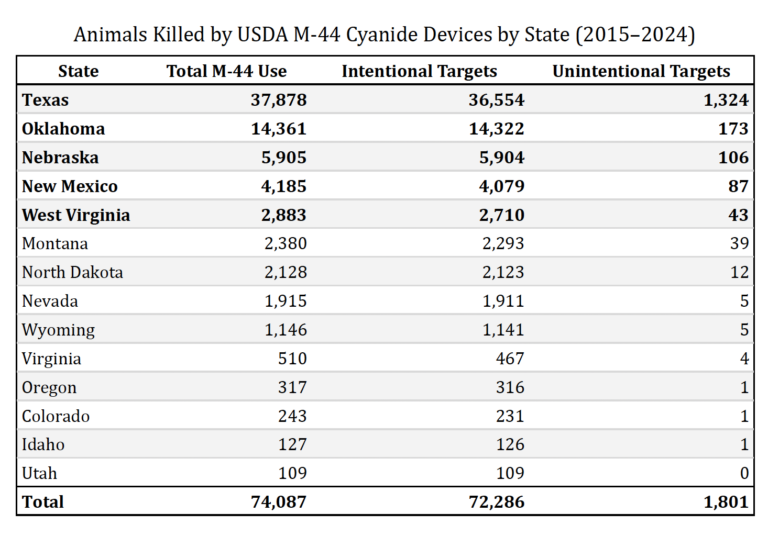
Despite these state-level restrictions, M-44s continue to be used elsewhere. Texas alone accounted for nearly half of all M-44 deployments between 2015 and 2024. During that ten-year period, USDA Wildlife Services reported deploying 87,949 M-44s across 14 states, resulting in the deaths of more than 2,000 non-target animals.
The table below summarizes M-44 deployments by state from 2015-2024, along with the number of target and non-target animals killed. All data is reported by USDA Wildlife Services.
Legislative Efforts and State Bans
Efforts to eliminate M-44s have repeatedly surfaced in Congress. In 2007, Representative Peter DeFazio introduced the Compound 1080 and M-44 Elimination Act, which would have prohibited federal use of cyanide devices. The bill never received a floor vote.
After the Mansfield incident, DeFazio reintroduced legislation as the Chemical Poisons Reduction Act of 2017. That measure also died in committee.
In 2021, lawmakers introduced H.R. 4951, better known as Canyon’s Law, to prohibit the use of M-44s and other sodium cyanide predator-control devices on federal lands. The bill was reintroduced in 2022, 2023, and again in 2025, yet Congress has never advanced the bill for a vote.
While Congress has failed to act, several states have taken matters into their own hands. In 1998, California voters approved a statewide ban prohibiting the use of sodium cyanide devices for predator control by any person, including government employees. Washington voters approved a similar ban through a ballot initiative in 2000. Oregon followed with Senate Bill 580 in 2019, banning sodium cyanide predator-control devices statewide. In 2021, New Mexico enacted Senate Bill 32, which prohibits traps, snares, and poisons on public lands. Because the law applies only to public lands, M-44s may still be used on private property.
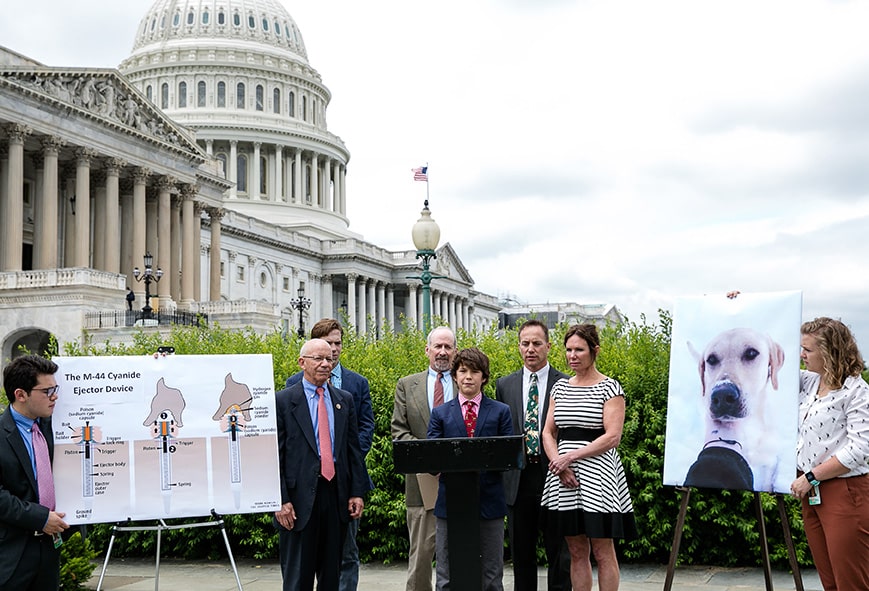
Canyon Mansfield answers questions on Capitol Hill about what happened the day he lost his dog to an M-44. Photo by Jenifer Morris/Predator Defense
A Federal Ban—and Its Reversal
In November 2023, the Bureau of Land Management prohibited the use of M-44 sodium cyanide ejectors across approximately 245 million acres of public lands it manages. Conservation organizations, scientists, animal welfare advocates, and public safety groups welcomed the decision as a significant step toward reducing risks to wildlife, pets, and people recreating on public lands.
That progress proved short-lived.
On April 15, 2026, the Trump administration rescinded the Bureau of Land Management’s prohibition through an internal Memorandum of Understanding between the Bureau of Land Management and USDA Wildlife Services. Disregarding the formal rulemaking process, the decision was implemented without a public comment period.
The reversal also came despite years of overwhelming public opposition. During the EPA’s 2019 public comment period on whether to continue registering M-44s, the agency received 22,390 comments. All but ten opposed reauthorization, reflecting widespread concern over the continued use of sodium cyanide ejectors. Although the Administrative Procedure Act requires agencies to consider relevant public comments, the EPA ultimately renewed M-44 registration.
Congress has likewise continued to support Wildlife Services’ predator control program. The House Fiscal Year 2026 Agriculture Appropriations Committee report includes language encouraging funding for the purchase, deployment, and training associated with M-44 devices used by USDA Wildlife Services.
As a result, M-44 cyanide bombs remain part of the federal government’s predator management toolbox despite decades of documented accidents, repeated lawsuits, growing public opposition, multiple state bans, and numerous unsuccessful attempts to prohibit their use nationwide. With the 2026 reversal of the Bureau of Land Management’s prohibition, the devices may once again be deployed across hundreds of millions of acres of public land throughout the American West.
Why Living with Wolves Supports a Permanent Ban

For more than fifty years, M-44s have remained one of the most controversial tools used in predator management. While supporters argue they provide an effective method of reducing livestock depredation, opponents point to their indiscriminate nature, documented impacts on non-target wildlife, risks to pets and public safety, and the suffering they inflict on animals.
Living with Wolves supports predator management strategies that prioritize prevention over indiscriminate lethal control. Decades of research have demonstrated that conflict mitigation practices—such as range riding, livestock guardian animals, improved husbandry, fladry, and other non-lethal deterrents—can reduce conflicts while minimizing risks to wildlife, domestic animals, and people. The organization has joined other conservation groups in signing petitions calling for an end to the use of M-44 cyanide devices and will continue advocating for their permanent prohibition.
The story of Canyon Mansfield reminds us that M-44s do not only affect wildlife. Hidden on public lands, these devices can have life-altering consequences for families simply enjoying the outdoors. More than half a century after their introduction, the question is no longer whether alternatives exist—it is whether we are willing to embrace proven solutions that reduce conflict while protecting both people and wildlife.
This compelling documentary “Lethal Control” offers additional perspective through the voices of the family at the center of this story and others working toward safer, more effective approaches to coexistence.