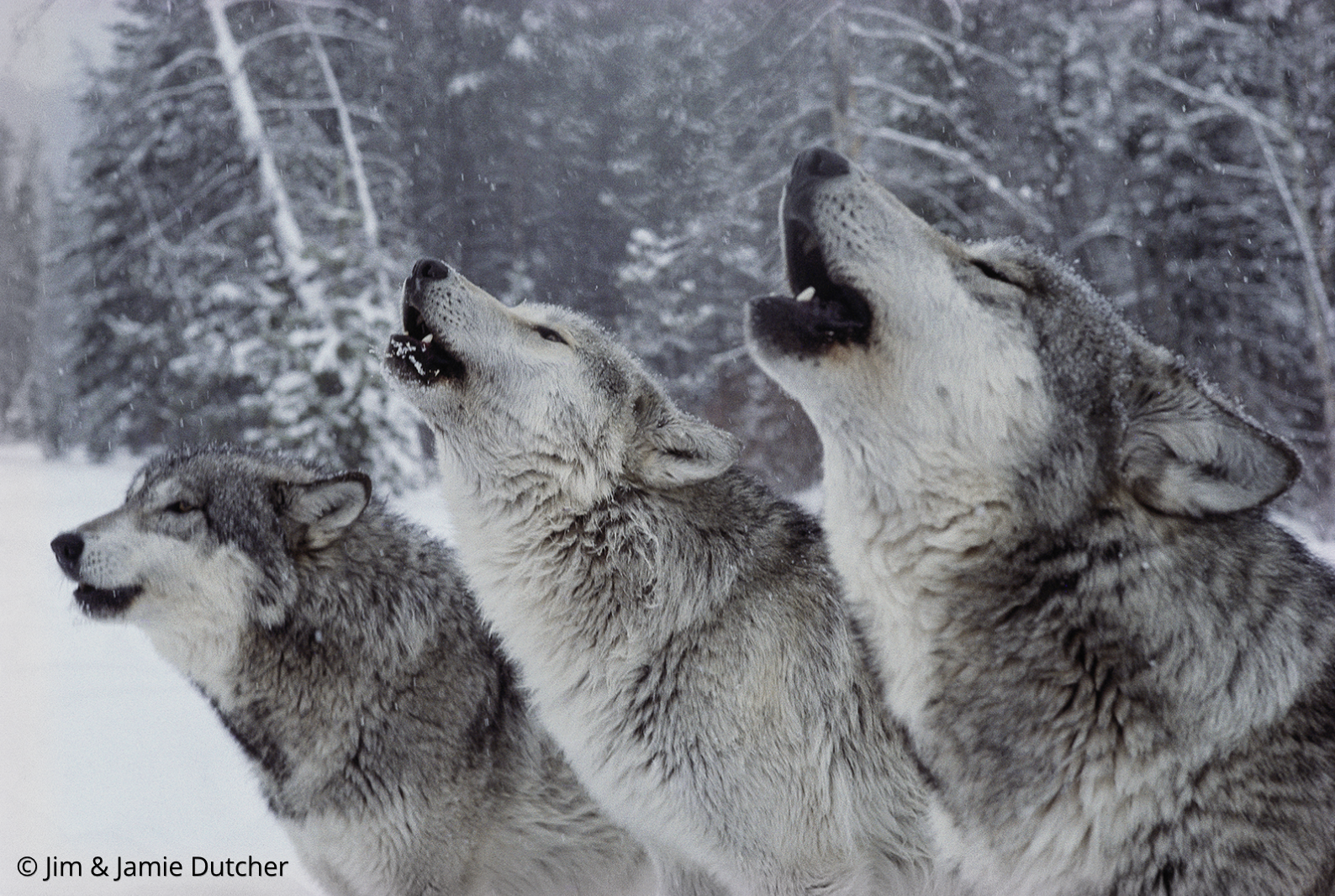


Wolves have evolved a unique hunting strategy built on cooperation, endurance, and generations of learned experience, allowing family packs to bring down large prey. Understanding how wolves hunt—and how their behavior differs from bears and mountain lions—is essential for appreciating their ecological role and making informed wildlife management decisions.
Wolves on the Hunt
Wolves hunt differently than any other large predator in North America. Rather than relying on brute strength or the element of surprise, they depend on cooperation, endurance, and generations of learned experience.
A wolf pack may pursue a herd for miles, testing animals for weakness and waiting for the right opportunity. They identify vulnerable prey through sight, sound, and scent, communicating with one another throughout the chase. Although wolves do not appear to have fixed hunting roles, individuals contribute in different ways depending on their age, experience, size, and the circumstances of the hunt. Some increase pressure from behind, others flank the herd or distract the targeted animal, allowing packmates to move in from another direction.
Body size can also influence hunting performance and how wolves contribute during hunts. Larger wolves, which are typically males, are generally better suited for grappling with and subduing large prey, while smaller wolves may have advantages in speed and maneuverability during pursuit. Most wolves contribute throughout the hunt depending on the circumstances. Wolves between two and three years of age are generally the most physically capable hunters, combining strength, speed, and endurance. Supporting Research
Despite their remarkable coordination, wolves are far from efficient hunters. Across studies, packs successfully kill prey in only about 15% of hunting attempts on average, although reported success rates range from roughly 5% to 28% depending on their prey species, habitat, season, and environmental conditions. Hunting success generally increases during severe winters, when deep snow makes it more difficult for prey to escape. Because so many hunts end in failure, wolves spend nearly one-third of their lives searching for and pursuing food.
Even with relatively low hunting success, working together is far more effective than hunting alone. A solitary wolf has only about a 2% chance of successfully killing an adult elk. This, along with the risks involved in hunting, is why wolves do not waste energy killing unnecessarily. Hunting is dangerous and costly, and the prey they kill provides critical food for survival. Wolves may return to carcasses for days or even weeks after a kill when conditions allow.
Read our related blog Wolves Do Not Kill for Sport.
Pack size also influences hunting success, although the ideal number of wolves depends on the prey being hunted. Research in Yellowstone National Park found that hunting success on elk increased with pack size up to about about four wolves, after which additional wolves provided little added benefit. Larger prey requires greater cooperation. Studies of wolves hunting bison found that capture success increased with pack size and began to level off around 9-13 wolves. These findings illustrate how wolves adjust their cooperative hunting strategy to match the size, behavior, and danger of different prey species.

Experience Matters
Physical ability alone does not determine hunting success. Older wolves are the keepers of knowledge that has accumulated over generations within a family pack. They know where prey migrate seasonally, which prey species are most vulnerable at different times of year, and what hunting strategies work best for each species. Even neighboring wolf packs may specialize in hunting different prey because those traditions are learned and passed from one generation to the next.
Unlike bears and mountain lions, whose young are raised primarily by their mothers before becoming independent, wolves spend their entire lives learning within extended family groups. Several generations often live together, allowing pups and younger wolves to observe experienced hunters for years and learn how to work as a team.
One of the best-known examples comes from the Toklat Pack, where researchers documented younger wolves learning specialized hunting strategies from older pack members through observation and experience.
The late biologist Gordon Haber observed that the Toklat Pack continually adapted its hunting strategy to weather, terrain, and prey behavior. The pack frequently hunted Dall sheep on the steep, rocky slopes of Alaska’s Denali National Park. Haber noted that the wolves consistently climbed above the sheep before attacking. Because Dall sheep are exceptional climbers and typically escape uphill, the wolves learned to anticipate this behavior and positioned themselves to cut off that escape route, sometimes waiting as long as two days to stage an ambush.
The story of the Toklat Pack also illustrates how fragile this learned knowledge can be. During the winter of 2005, the alpha female was caught in a snare. Two other females remained by her side until they were eventually all killed. After losing his mate, the alpha male repeatedly returned to the site for months before he, too, was killed by a hunter.
The remaining six wolves of the pack were all juveniles. Without the experienced adults to teach them how to hunt Dall sheep, that specialized hunting strategy was abandoned and they survived primarily by hunting snowshoe hares during the winter. The loss of the older wolves meant the loss of knowledge that had been built over generations, a unique hunting tradition, or “pack culture.” that was distinctive to the Toklat Pack.
When experienced wolves are removed through hunting, trapping, or other causes of mortality, that knowledge can disappear with them. Young wolves may be left without experienced pack members to teach them how to hunt wild prey efficiently and, as an unintended consequence, may be more likely to target easier prey such as livestock.
Competition Among Predators
Large predators do not simply compete with prey—they also compete with one another.
Wolves and bears will frequently steal kills from one another whenever the opportunity arises. A wolf pack may drive a mountain lion away from its hard-earned kill through sheer numbers, while grizzly bears commonly displace both wolves and mountain lions from carcasses because of their immense size. These interactions are a normal part of life in ecosystems where multiple predators coexist.
Watch this short video of Yellowstone’s Junction Butte Pack returning to an elk they had killed, only to discover that a grizzly bear had claimed the carcass:

Solitary Hunters vs. Pack Hunters
Bears and mountain lions are ambush predators built for power. They rely on explosive bursts of speed, overwhelming force, and surprise to subdue prey. Their muscular forelimbs and long claws allow them to seize, hold, and overpower struggling prey, while their powerful jaws deliver a quick, often fatal bite.
Wolves are built very differently. They are coursing predators, adapted for endurance rather than brute force. Their long legs allow them to pursue prey over long distances, while their claws provide traction rather than serving as weapons. Their elongated snout gives them an exceptional sense of smell but limits the force they can deliver through the front of their jaws. Instead of relying on a single killing bite, wolves wear prey down through persistence before using their canine teeth to grip, pull, and tear while working together to exhaust and subdue the animal. They crush bones using the powerful premolars and molars farther back in their jaws.
Because wolves cannot quickly overpower large prey, every hunt carries significant risk. Elk, moose, deer, and bison are all capable of seriously injuring or killing wolves with kicks, hooves, antlers, or horns. Cooperation allows wolves to overcome prey much larger than themselves, but it does not eliminate the dangers they face.
Why Hunting Strategies Matter
Understanding how predators hunt is more than an academic exercise—it has practical consequences for wildlife management. Each predator leaves behind different evidence at a kill site. Bite placement, feeding patterns, caching behavior, tracks, scat, and other signs can help trained investigators determine which predator was responsible. To an untrained observer, however, these differences are not always obvious. A mountain lion kill, for example, may be mistaken for a wolf kill.
This is why trained wildlife professionals play such an important role in livestock depredation investigations. Careful examination of the evidence helps ensure that management decisions, compensation programs, and public reporting are based on accurate identification rather than assumptions.
The Strength of the Pack
Wolves are not successful because they are the strongest predators—they are successful because they work together. Their ability to cooperate, communicate, and pass knowledge from one generation to the next allows them to thrive despite the challenges of hunting large prey.
Protecting stable wolf families helps preserve these learned behaviors, strengthens the pack’s ability to hunt wild prey, and maintains the ecological role wolves have developed over thousands of years. Understanding how wolves hunt, and how their strategy differs from bears and mountain lions, leads to better science, better wildlife management, and a greater appreciation for one of North America’s most remarkable predators.