

Wisconsin’s wolves have endured nearly two centuries of persecution, protection, recovery, and political debate. Today, with federal protections once again under threat, understanding that history is essential to recognizing what could be at stake for the state’s wolves—and what may happen if management authority returns to Wisconsin.
A Recovery Story Still Being Written
For thousands of years, wolves have been part of Wisconsin’s landscape. What has changed dramatically is how people have viewed—and managed—them. Once widespread across the state, wolves were systematically killed until they disappeared from Wisconsin altogether. Decades later, protected by state and federal law, they returned naturally and became one of the state’s most remarkable wildlife recovery stories.
Today, with roughly 1,000 wolves living in Wisconsin, that recovery has given way to renewed debate over hunting, livestock conflicts, population levels and the role wolves should be allowed to play on the landscape. Wisconsin’s wolf story, then, is about more than the return of a native species. It is a story of shifting policies, competing values and a population whose future has repeatedly depended on the choices people make. To understand what may come next for Wisconsin’s wolves, we first have to understand how we got here.
Unmanaged Killing
Wisconsin first started killing wolves in 1839 through government-sanctioned bounties, when the area was still a U.S. territory. When it gained statehood in 1848, the practice continued. In 1865, the state legislature formalized a $5 bounty for each wolf killed. At the time, wolves were widely viewed as predators of livestock that needed to be removed from the landscape. Over time, the bounty continually increased up to $20 for an adult wolf and $4 for pups.
This was not an isolated effort. Across much of North America, government agencies, settlers, and hunters participated in campaigns designed to eliminate predators. Wolves were trapped, shot, poisoned, and pursued wherever they were found. By 1957, fewer than 50 wolves were estimated to remain in the northern part of the state when the Wisconsin Department of Natural Resources (DNR) ended the bounty program and classified the remaining wolves as a protected species, marking the first state in North America to do so.
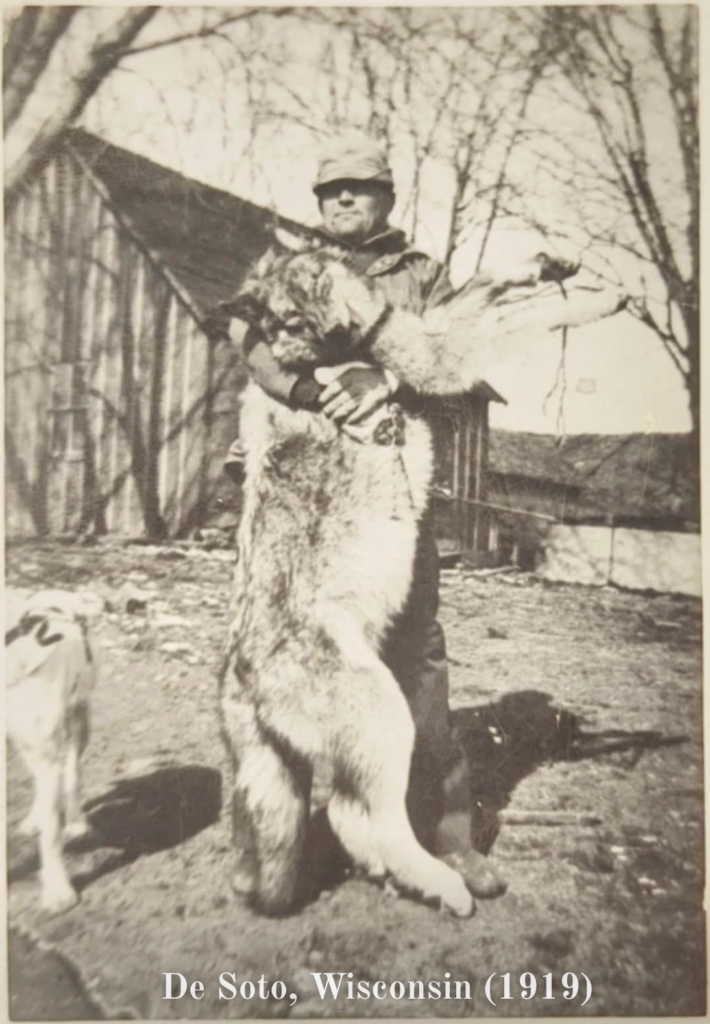
However, due to almost a century of unregulated hunting and trapping, wolveswere considered extirpated by the 1960s. The disappearance of wolves was not the result of one event or a single policy. It was the culmination of sustained killing, habitat changes, and the broader transformation of Wisconsin’s landscape.
Wolves Come Back
Fortunately, the disappearance of wolves from Wisconsin did not last forever. During the 1970s, wolves naturally returned, primarily dispersing eastward from Minnesota. Rather than being reintroduced by people, these wolves crossed into Wisconsin on their own, expanding into available habitat.
The passage of the federal Endangered Species Act in 1973 added another layer of protection. Gray wolves were listed as endangered in much of the contiguous United States, and by 1978 the gray wolf was listed as endangered throughout the contiguous United States except Minnesota, where wolves were classified as threatened. Federal protection meant that wolves could begin rebuilding their population without facing the same government-sponsored persecution that had previously driven them to extinction.
By 1999, the Wisconsin Department of Natural Resources estimated that approximately 200 wolves lived in the state and developed its first formal Wolf Management Plan. The plan set a management goal of 350 wolves—a figure that was not based on Wisconsin’s biological carrying capacity, but emerged largely as a compromise among competing social and political interests during the planning process.
The plan also established state-set benchmarks for recovery and delisting. By 1999, Wisconsin had already surpassed the threshold of 80 or more wolves for three consecutive years, qualifying the population for reclassification from endangered to threatened. State delisting would follow once the population reached 250 wolves outside Native American reservations.
Wolf numbers continued to rise from 83 in 1995 to 248 by 2000, surpassing the state delisting threshold soon afterward and eventually exceeding the 350-wolf management goal. As wolves recovered, expanded across suitable habitat, and surpassed established recovery benchmarks, the conversation increasingly shifted from restoring the population to delisting wolves and determining how the state would manage them afterward.
The Debate of Federal Protection
Wolf recovery eventually led to a new question: When does a recovered species stop needing federal protection? The Western Great Lakes wolf population was repeatedly the subject of federal delisting efforts. In 2007, the U.S. Fish and Wildlife Service officially removed the Western Great Lakes population from the Endangered Species List, arguing that populations in Minnesota, Wisconsin, and Michigan had recovered. Court challenges subsequently resulted in protections being restored and removed again at various times. This back-and-forth became a recurring feature of wolf management, not only in Wisconsin.
When federal protection was removed, management authority returned to states and tribes. When federal protection was restored, state hunting and lethal management programs had to stop.
Wisconsin’s legislature attempted to establish what would happen during those periods of delisting. In 2011, Wisconsin enacted Act 169, requiring the state to hold an annual wolf hunting season if wolves were removed from the federal Endangered Species List. That law would become especially important a decade later.
Wisconsin's Wolf Hunts
Wisconsin held its first wolf hunting season in 2012, after federal protections were removed, killing 117 wolves. The following season, 257 were killed, followed by 154 in 2014. These hunts quickly demonstrated how dramatically wolf mortality could increase once management returned to the states.
By December 2014, a federal judge overturned the Western Great Lakes delisting rule and restored Endangered Species Act protections to wolves. The ruling raised concerns about whether state management systems provided adequate safeguards once federal protections were removed, particularly as human-caused mortality increased and wolf populations steeply declined. Wisconsin’s wolf hunt was halted with the return of federal protection.
The 2021 Wolf Hunt
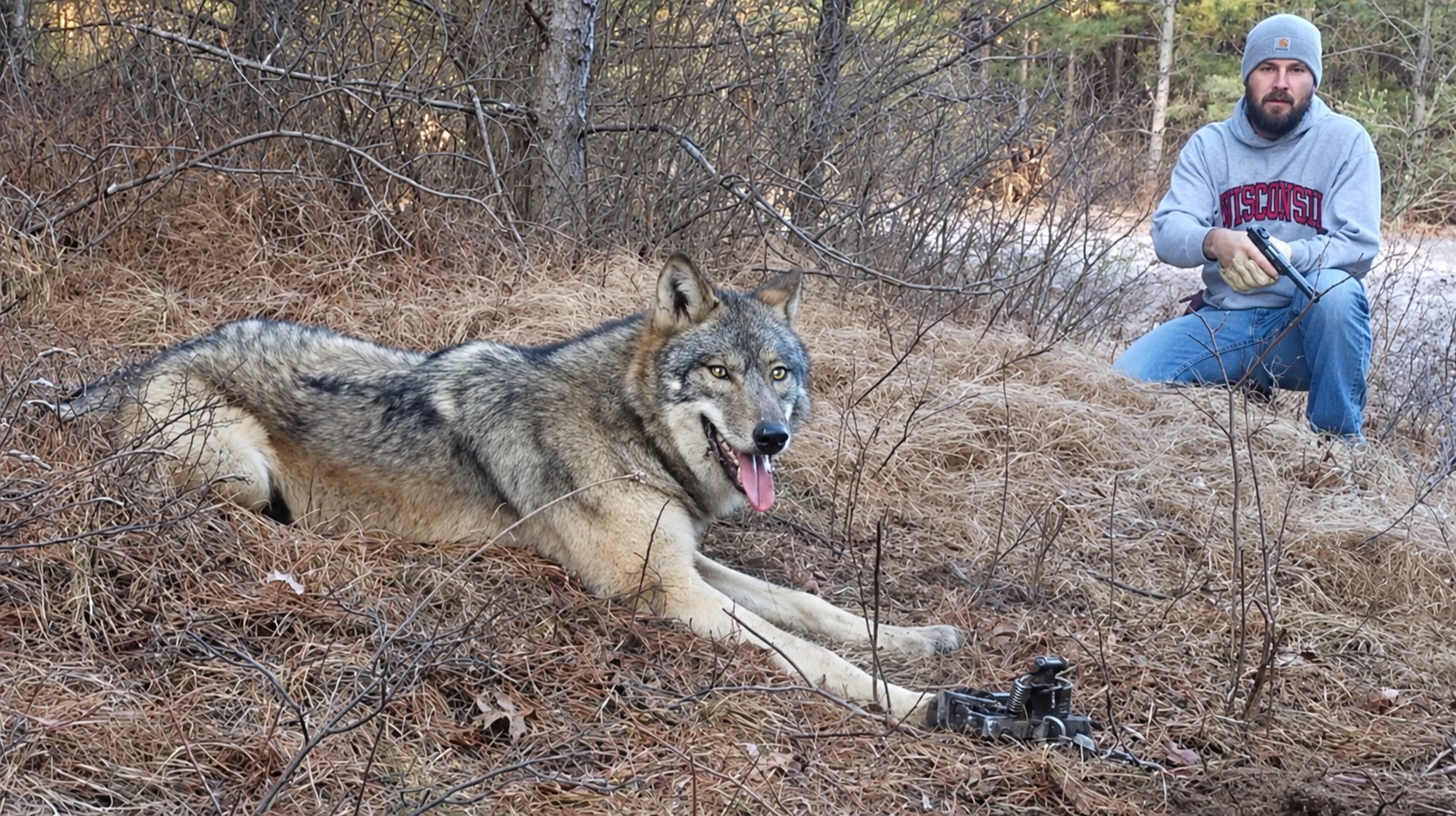
On January 4, 2021, federal protections for gray wolves still protected in the lower 48 states were removed. Management authority returned to the states and tribes, and Wisconsin’s law required a wolf hunting season. Wisconsin’s Natural Resources Board initially determined that a hunt would not take place until November. But a lawsuit brought by Hunter Nation resulted in a court order requiring Wisconsin to hold a hunt even sooner.
The resulting February season would become one of the most controversial wolf hunts in Wisconsin history.
The state established a quota of 119 wolves for state hunters and trappers. Another 81 wolves were allocated to the Ojibwe tribes under their treaty rights, creating a total quota of 200 wolves. In Ojibwe culture the wolf (ma’iingan) is considered sacred and deeply revered, as such the tribes chose not to hunt their allotted wolves, effectively leaving those animals protected. More than 27,000 people applied for the opportunity to participate, and 2,380 licenses were issued.
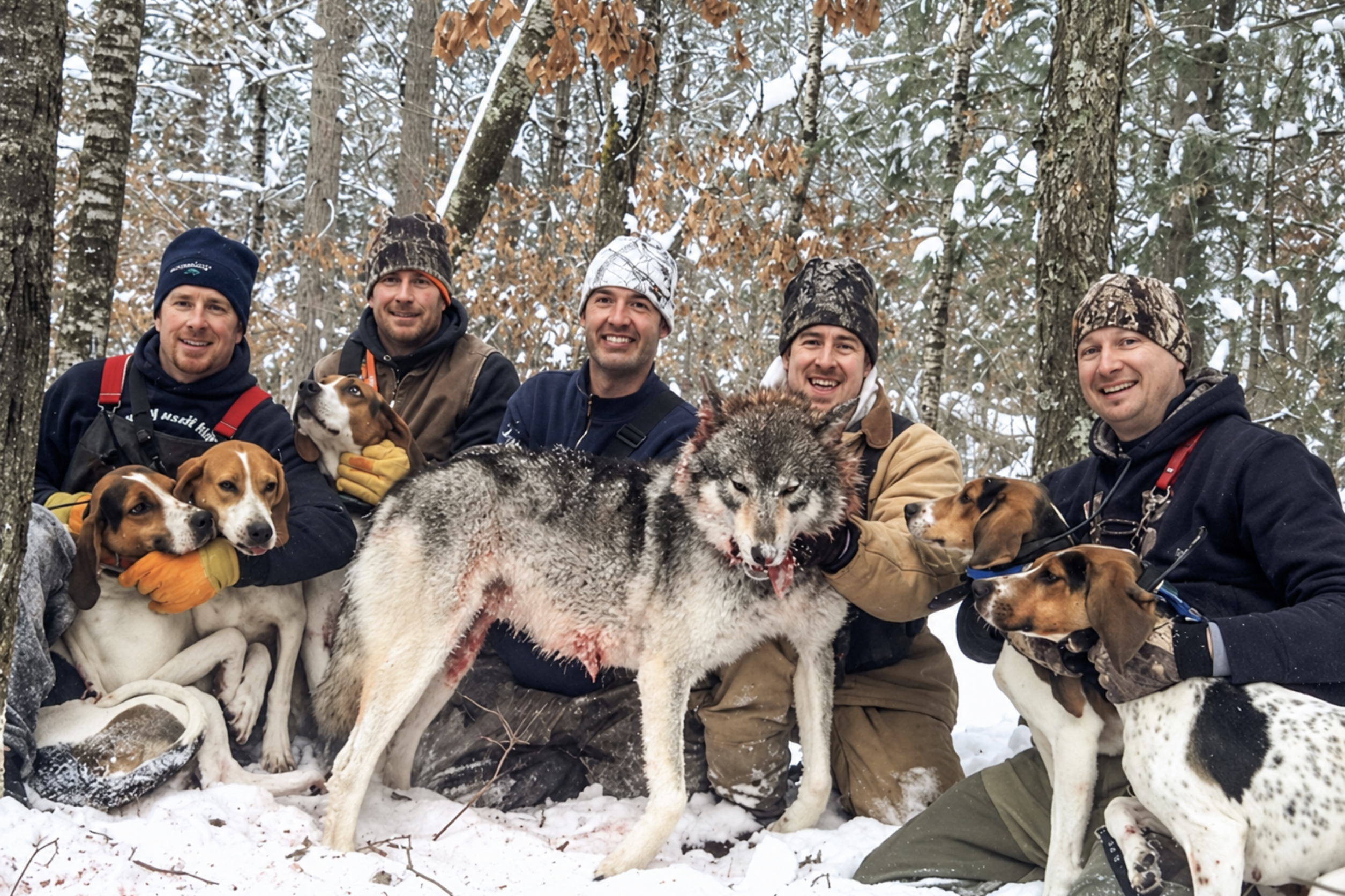
The season opened February 22, 2021, during peak mating season. It was supposed to last a week. Instead, Wisconsin’s wolf hunters reached and surpassed the state quota in less than three days. By February 24, all six harvest zones had been closed. The DNR acknowledged that state law requiring 24 hours’ notice before a closure, likely impacted the quota being exceeded by so much.
The final number of wolves killed was 218—83% above the state quota of 119. The speed and scale of the overrun raised serious questions about whether Wisconsin’s management system was capable of controlling wolf mortality once a hunt began.
And the consequences went beyond the number killed. Of the 218 wolves taken, 86 percent were hunted with the aid of hounds. Critics argued that a statewide winter hunt, particularly one involving hounds, was poorly suited to addressing livestock conflicts because much of the hunting occurred far from farms experiencing depredations. And because the hunt took place during the wolves’ breeding season, the disruption extended beyond individual animals to packs during a critical period of courtship, territory defense and reproduction.
The Hunt Is Stopped
In response to a lawsuit filed by conservation groups in August of that year, a Wisconsin judge ruled that the DNR had failed to go through proper rulemaking when establishing the wolf harvest quota, and was instead relying on emergency rule adopted roughly a decade ago. This ruling came two weeks before the fall wolf hunt was scheduled to begin on November 6, 2021. In issuing his October 22 ruling, Circuit Court Judge Jacob Frost was reported saying,
“The DNR needs to stop it. They need to actually comply with the law. They need to regulate the hunt. They need to develop a wolf management plan. They need to implement rules so they can regulate the hunt. They need to be part of that oversight process that keeps the law constitutional.”
In essence he was saying the Legislature could require a wolf hunt, but DNR couldn’t implement that law indefinitely through an old emergency rule without going through the permanent rulemaking process required by Wisconsin law. The Dane County Circuit Court issued a temporary injunction and set the fall 2021 wolf season quota and issuable harvest licenses to zero, until further steps were taken. The state began working on a new Wolf Management Plan and hunting regulations. But before Wisconsin could hold another hunt, federal protections returned.
On February 10, 2022, a federal court restored Endangered Species Act protections for gray wolves across most of the lower 48 states. Wisconsin was once again under federal jurisdiction for wolf management, and ended the state’s ability to conduct a wolf hunt. It also stopped lethal depredation control under Wisconsin’s state program.
A New Management Plan
Even while wolves remained federally protected, Wisconsin continued developing their new management framework. From 2021 through 2023, the DNR worked with a 29-member Wolf Management Plan Committee, Tribal Nations, the Great Lakes Indian Fish and Wildlife Commission, and other agencies, scientists, organizations, and members of the public. The process included thousands of public comments. The result was the 2023 Wisconsin Wolf Management Plan, approved by the Natural Resources Board in October 2023.
At the time, approximately 1,000 gray wolves lived in Wisconsin, concentrated primarily near the state’s northwestern border with Minnesota, just below the state’s estimated biological carrying capacity of roughly 1,200 to 1,300 wolves.
Rather than managing toward a single statewide population target, the new plan calls for “adaptive management,” generally maintaining the wolf population within a range of 800 to 1,200 wolves while allowing local wolf densities to fluctuate as conditions change. The range is intended to reflect both the state’s estimated carrying capacity and public preferences for maintaining approximately the same number of wolves or more. Those preferences are based on a 2022 survey of Wisconsin residents, conducted when approximately 1,000 wolves lived in the state.
The shift toward adaptive management is intended to allow the state to respond to changing conditions rather than treating a specific population number as a fixed endpoint. As Randy Johnson, a large carnivore specialist with the DNR, explained, choosing one “right number” of wolves can be subjective and “biologically and politically tricky.”
The plan also introduced several changes to how wolves are hunted and managed:
- Shorter registration period for killed wolves. Hunters must now report a kill within eight hours, rather than the previous 24-hour window, which contributed to the quota being exceeded during the 2021 hunt.
- Restrictions on hound training and use. Training is permitted only when the corresponding hunting zone is open, rather than year-round. Hunters are also prohibited from using hounds to pursue wolves at night.
- New zone-specific hunting quotas. During the 2021 hunt, hunters could receive tags valid statewide, allowing them to move into areas that remained open as other zones closed. The new system is intended to prevent this cascading concentration of hunting pressure by establishing quotas specific to each zone.
- Lower quotas around Native American reservations. Where requested by tribes, subzones extending six miles from reservation boundaries will have lower hunting quotas. These areas are intended to provide additional protection for wolf packs associated with reservation lands.
While the plan outlines strategies for increasing public education about conflict mitigation, there is comparatively little emphasis or dedicated resources for putting those strategies into practice.
From Bounty to Conservation—and Back Again?
Wisconsin’s wolf history is more than a story about whether people like or dislike wolves. It is a story of how quickly our relationship with a native predator can shift—from eliminating wolves from the landscape, to protecting their return, to once again debating how many should be allowed to remain and under what conditions.
In less than two centuries, Wisconsin went from paying people to kill wolves, to watching wolves disappear, to protecting their return, to debating how many could be killed again. The wolves themselves have not changed nearly as dramatically as our policies toward them.
The central challenge remains the same one that has shaped wolf management for decades: How can Wisconsin ensure that wolves remain a healthy, functioning part of the landscape while addressing the conflicts that come with coexistence? The answer will determine whether Wisconsin’s wolf story becomes one of lasting recovery—or another cycle of protection, persecution, and recovery.
What Happens if Wisconsin Wolves are Delisted Again?
As of the publication of this article, gray wolves in Wisconsin are federally listed as endangered and protected under the Endangered Species Act. But that protection could change. H.R. 845, the ironically named Pet and Livestock Protection Act, would remove gray wolves in the Lower 48 from federal protection and return management authority to the states. The bill has already passed the U.S. House of Representatives and is now before the Senate.
For Wisconsin, delisting could have immediate consequences. Under state law, Wisconsin is required to hold a wolf hunting and trapping season whenever wolves are no longer federally or state listed as endangered. That means if H.R. 845 becomes law, Wisconsin could once again be required to authorize a wolf hunt.
If you want to help prevent another devastating wolf hunt, contact your U.S. senators and urge them to vote NO on H.R. 845. Call, email, or write a letter and tell them that all wolves in the Lower 48 need continued federal protection.
Use the button below to find your senators’ contact information and make your voice heard!